The WordPress engine has cracked
By The TinaCMS Team

If you use WordPress for your websites you've likely had a headache of a week. Meanwhile TinaCMS users have been sleeping like babies.
WordPress runs on PHP, on October 21, 2026, the PHP project released emergency fixes for 2 critical vulnerabilities: CVE-2026-109618 and CVE-2026-109619, known together as PHP2Shell.
- Both flaws can let an attacker run code on your server without logging in
- The flaws are in PHP, not WordPress or a plugin, so a WordPress update doesn't fix them
- Update PHP, or ask your host to
PHP fix: Patch now
There are 2 ways to patch your site, depending on who manages your PHP installation:
- A managed host runs it. Ask your host to confirm they applied both fixes and restarted PHP.
- You run the server. Update PHP to the fixed release for your version, then restart the services that use it:
- 8.5.12
- 8.4.27
- 8.3.36
- 8.2.35
- PHP 8.1 and older get no fix from the PHP project, so get vendor guidance
To see a site's PHP version, open Tools > Site Health > Info > Server in WordPress.
Risk is highest on Apache with mod_php.
Researchers showed an attack there that runs before any application code, so a WordPress login can't protect you.
Exposure is a reason to patch, not proof of a break-in.
See the PHP security advisory for details.
Why do customers still choose WordPress?
Teams choose WordPress for good reasons: clients are familiar with its editor, and developers know how to build and deliver sites with it. It's also basically everywhere: W3Techs measured it at 39% of all websites on October 23, 2026. But you also maintain everything under the pages.
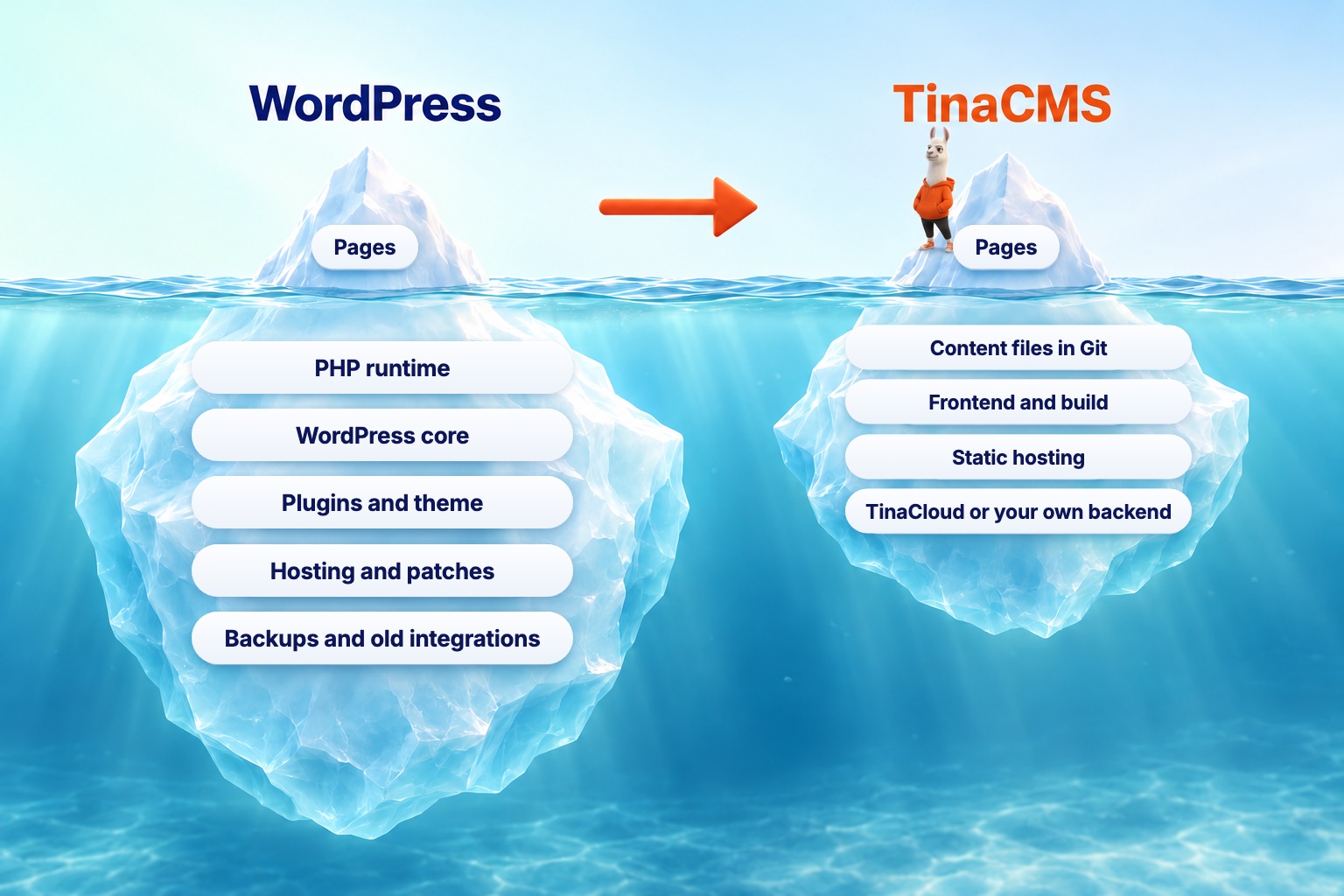
Figure: Move from WordPress to TinaCMS. Faster site and smaller attack surface
Sizing up the move
Removing PHP means replacing WordPress. That can involve untangling themes, page-builder layouts, custom fields and publishing workflows.
To size that cost, ask:
- How much content is useful outside the current theme and plugins?
- Can another developer rebuild the site from documented access, or does it depend on one person's memory?
- What Claude subscription do you have? 😜
Better solution… TinaCMS
TinaCMS stores content as Markdown, MDX and JSON files in your GitHub repository. Editors get a CMS interface, and each save is a commit. TinaCloud runs the editor backend, or you can self-host it.
You build the frontend with Astro, Next.js or another React framework.
Try it with a pilot
- Start a TinaCMS project:
npx create-tina-app@latest - Pick 2 or 3 representative pages, including an awkward layout
- Move content and media with our WordPress to TinaCMS guide. Design and plugin behavior need separate work.
- Keep existing URLs, or map redirects
- Have a real editor do their normal tasks on a preview deployment
Speed it up with AI ✨
An AI coding assistant can scaffold the pilot from a screenshot. Our vibe blogging walkthrough shows how.
WordPress is legacy software, built for the web 23 years ago and older than some of our TInaCMS developers! The PHP2Shell exploit is a good reason to reopen this conversation, and build a quick prototype to nail the discussion.
For help with the move, join the TinaCMS community on Discord.